March 21

The Old Racetrack in Jacksonville

On a recent hunt, I tried to find any remnants of the “Old Jacksonville Racetrack” of Duval County, also known as the Jacksonville Speedway.  I was told it had been located near the intersection of Lenox Avenue and Plymouth Street on the westside of the city. At one time, it was “the” place to race an automobile.
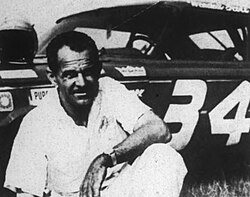
All that was there though, was a huge conglomerate of apartments named Madelyn Oaks formerly Lenox Court Apartments.  5710 Lenox Avenue was gated but not a racer to be seen,  so I traveled the road to talk with anyone who might know.  At Pugh Automotive, I got some answers.   Lee, an office worker said the track was indeed where the apartments now sit and he spoke a great deal about what had once been a busy and fun place. He noted that Wendell Scott, the first Black person to win at racing had made his mark there, along with many others. 
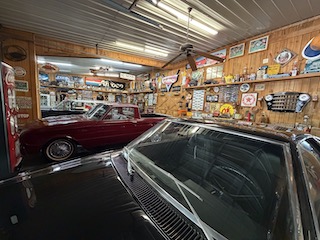
Being in the automotive business, he was obviously familiar with the racing industry and on the Pugh property were various cars dating back to the days the track was just yards away.  I asked if he had a race car on the property. He said “no,” but there then he took me inside the shop to show me a framed race car photo from the days of the busy track. Also he noted for me to look at the vintage autos all around.  They were beautiful along with the memorabilia and collectibles around the room and on the walls. 
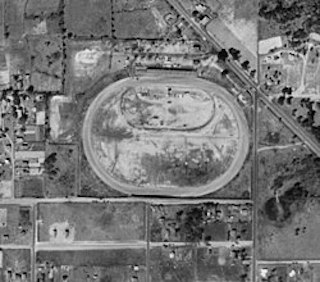
Wikipedia has a 1952 aerial photograph of “Speedway Park” which opened in 1947. It closed in 1972. The track was a 0.5 oval dirt tract which was used for auto races including NASCAR Grand National Series. 
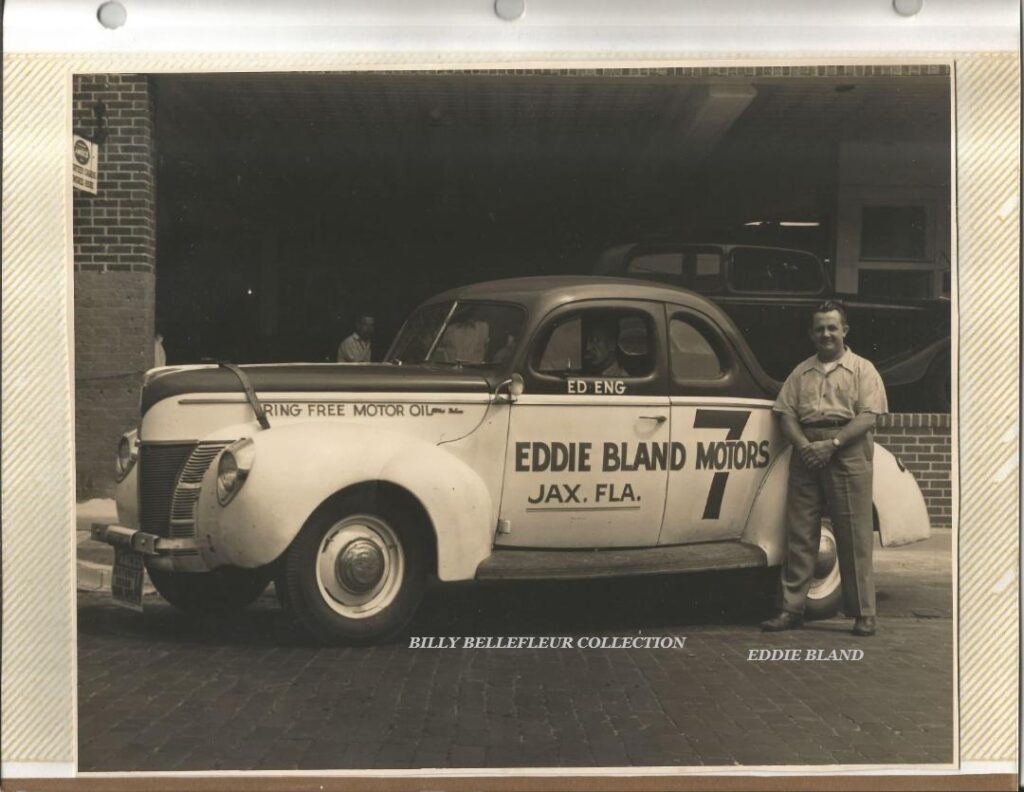
Eddie Bland (1904-1968) built the racetrack on family farm land in 1946.  He had been an avid race car driver winning 3 Florida State championships. His 1934 cars were # 11 and # 8. After WWII, he built the 1/2 mile speedway and in March of 1947 the track had its first stock race. It became known as “the fastest 1/2 mile dirt track in the world” according to Forumation. com.  Bland is considered one of the “true pioneers in the southeastern world of stock car racing.”  He was inducted into the Jacksonville Stock Car Racing Hall of Fame in 1998.
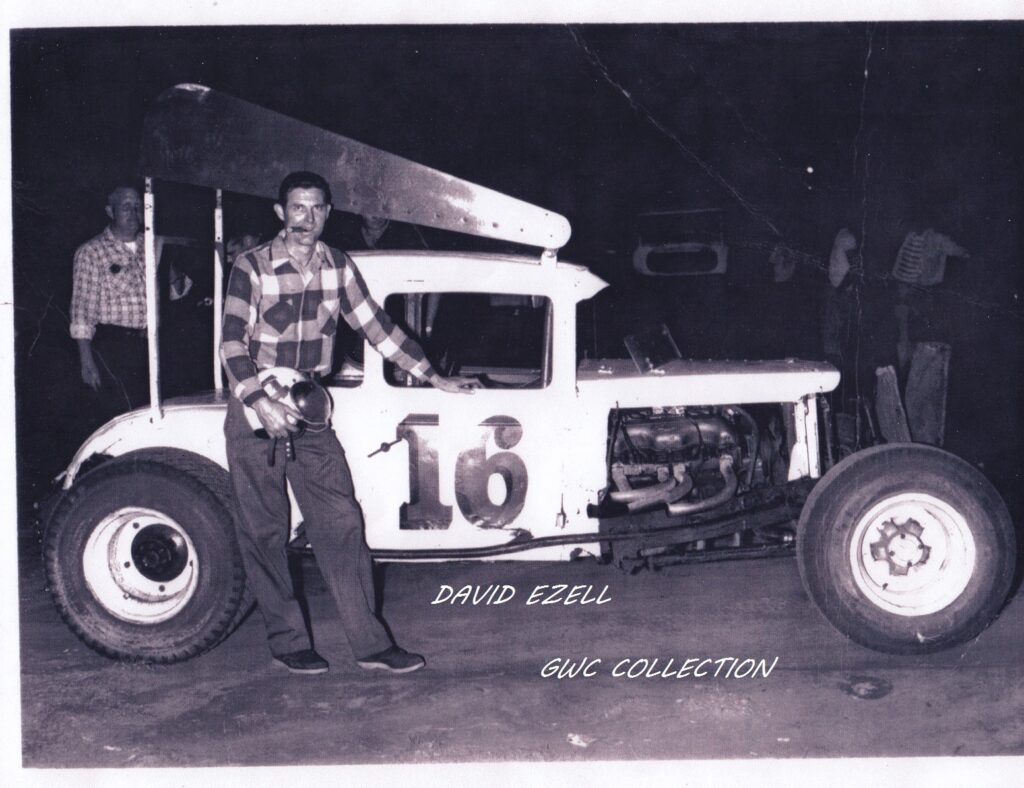
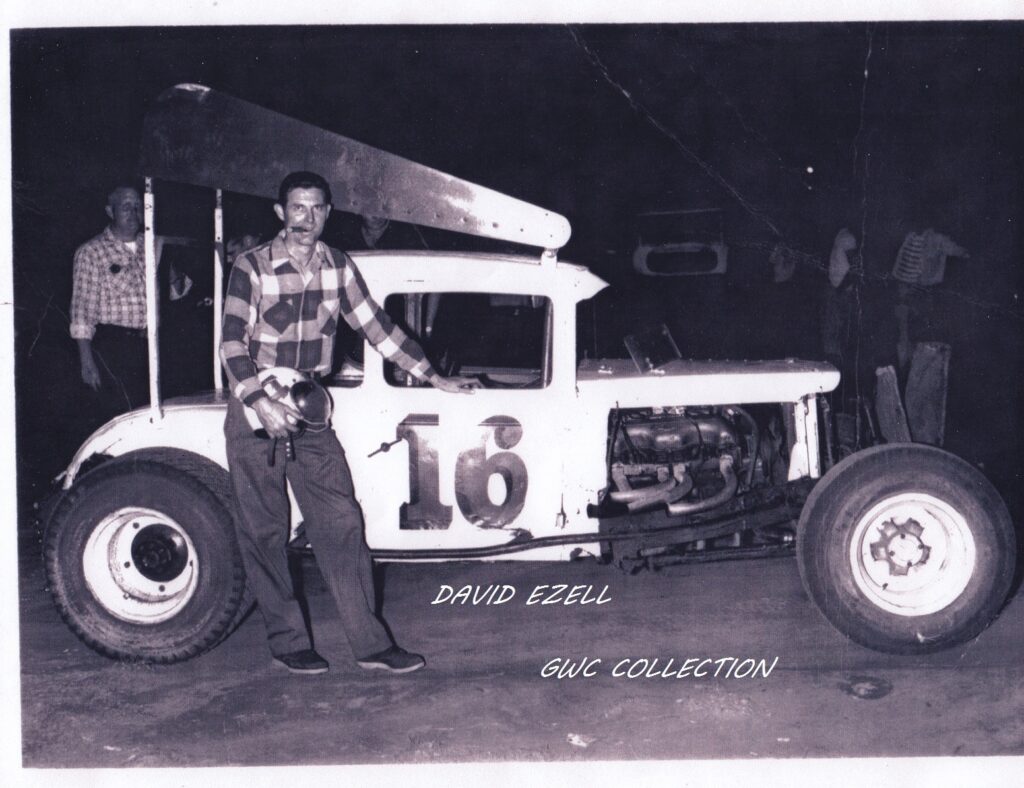
In talking to a high school friend, Wayne Ezell, he tells about the life of a stock car driver being “all in or nothing” and says that his father, David was “all in”. David Ezell (1928-2013) had been a Navy veteran and well known stock car driver.   His son, who had also raced on the track,  tells that his family of 5; his Dad, Mom, an older sister, younger sister and self lived the lives of a racing family. David was inducted into the Jacksonville Stock Car Racing Hall of Fame in 1991.

In scanning the Facebook Speedway site, Bob Robert-Hoden wrote of Ezell, “That man could drive good. He was the Earnhardt of the 50’s and 60’s”. Frank Ridden wrote, “ That was my man back then”. Wayne Davis wrote, “David Ezell was my absolute favorite driver at the old Jacksonville Speedway part he always took time to come speak to me when I was a little feller when I was at the fence, separating the pits in the infield, and I’ve never forgot that and hopefully I never will. I always tried to emulate that in my racing career.”

Of David Ezell, George Collins, an Admin for the Jacksonville Speedway Facebook page wrote:

“Too little is said about David Ezell, probably the most under-rated driver evere to turn a wheel at the old speedway. David probably won more races accidently than many could brag about on purpose. If truth be known, he most likely wore out more cars than he wrecked. This one he didn’t get to wear out, although he drove it two seasons or three. This was his first race car, a 39 Ford deluxe coupe. I just noticed it has 1938 standard fenders.”
The Jacksonville Speedway opened in 1947. Iy would host NASCAR Grand National Series in 1951, 1952, 1954, 1955, 1961, and 1964. It would also host the race for Wendell Scott, the first Black to win. NASCAR top series.  
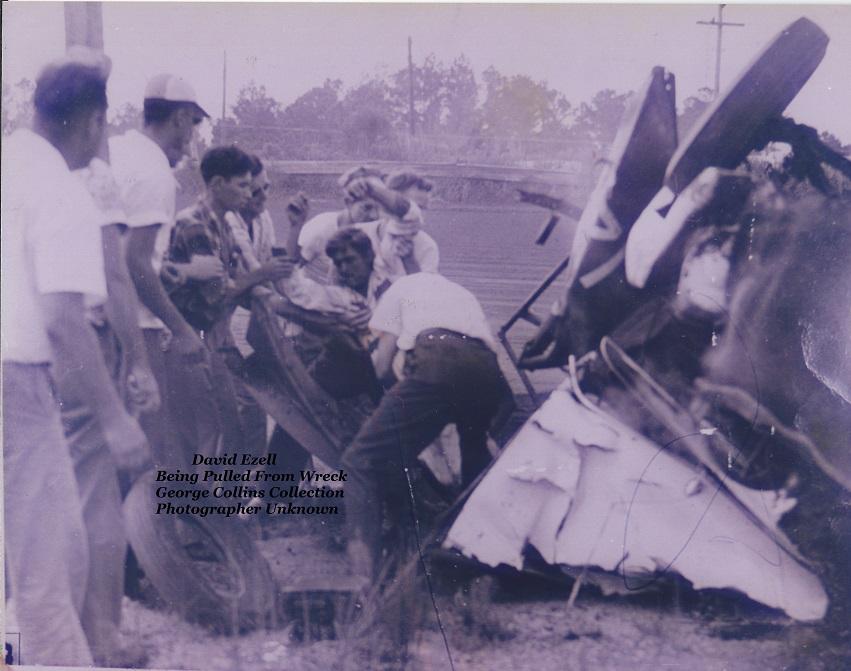
Following the NASCAR Grand National East Series, the track was closed in 1973 and today a housing development fills the property.  

See you tomorrow,

Sources: David Wayne Ezell, Pugh Automotive, “ Lee”, Jacksonville Stock Car Racing Hall of Fame, Wikipedia, Forumotion .com, Photos: George Collins, Hazel W., Facebook, Wikipedia, Vaughan Publishing, Nannette V. Ramey
Category: History, People, Sports, Westside | Comments Off on The Old Racetrack in Jacksonville
March 12

Our Olympic-Sized Pool

My Mother was a stay-at-home Mom. She shopped at a store on San Juan that had bent cans and sale racks.  In my mind, she scrimped and saved all of the time. I was never was aware of her splurging unless you call getting a Krystal Burger on occasional Wednesday night after church a splurge (and we could only have one with water to drink.) Those were the happiest of days too!

Daddy worked for the government.  After coming out of the Army in the mid 1940’s from Camp Landing, he moved the Jacksonville to be close to his sweetheart(my Mom) then got a job at NAS Jax. 

My parents married at Riverside Baptist Church in Jacksonville.  They bought a house, site-unseen with a small down payment.  With little money and only one salary coming in they scrimped and saved  even more. They then,  put money on a down-payment for a 10-acre plot on the Westside of Jacksonville.  I was about 7 at the time but I even remember the conversations about being careful with money as Mama would take Daddy to work so they both could use the car.  She would pick him up after work, then we would all go to the property and work on the house until dark.

The home was a Jim Walter home and Daddy and mama figured out the rest using what  little resources and money they had. In a recent water leak at the property, some 60 years later, we found that Daddy used a spark plug to close up a water line. The funny thing was the spark plug was still working. It was a break in a corner coupling that had given way.  We all had to laugh at his ingeniuity.

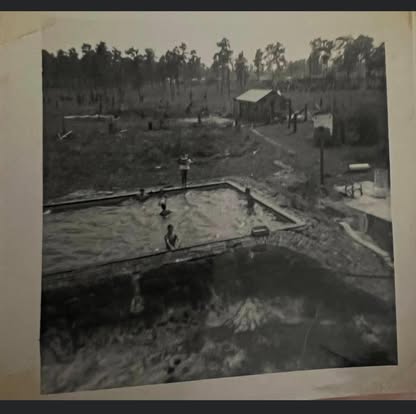
By the time I was 10 we were swimming and having pool parties at our  20 x 40 sized swimming pool we had dug with our own hands.  Because my parents had no “real” money, there was no renting a bucket truck so everyone had a shovel and we would shovel until dark and drop into bed.  It took, days, and months to dig. To help the situation, Daddy used cinder blocks to raise the sides high. At end-result we had a pool with a 3 foot depth on one end and 6 1/2 footer at the other.  A liner was used on the sides and into the base of the pool and we used a deep well to fill it.

To make it really nice, our parents had purchased from the train station literally thousands of bricks so bricks were used for the top walk ways and coming down on the sides.  It actually was so pretty when finished. Here we were, people without money with a beautiful pool that made us feel like rich folk.

See you tomorrow

Sources: Vaughan Publishing, Nannette V. Ramey 
Category: Family, Finances, History, Westside | Comments Off on Our Olympic-Sized Pool
March 1

The Lee Log Cabin

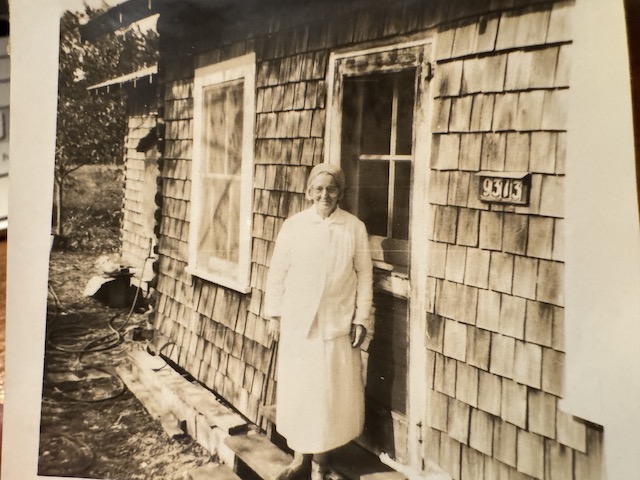
Idell Virginia Highsmith Lee was truly a pioneer in the 20th century and she lived in a log cabin to prove it. She married Ezra Marmaduke Lee on April 22, 1923 in Duval County, Florida. Together they built a real log cabin at 9313 Crystal Springs Road on Jacksonville, Florida’s westside. When I met “Granny Lee”, her husband Ezra of 39 years had recently died leaving her alone in the cabin but with grandkids all living on the land next to her. 

My memories of Granny are fond. She celebrated the many who dropped by to see her. They were always welcome in her 2 br family-built log cabin.  She told me that she, Ezra and with some neighbor’s help build the cabin not long after they married.  It was a long project and took some time to build but it was theirs and they were so proud of it.

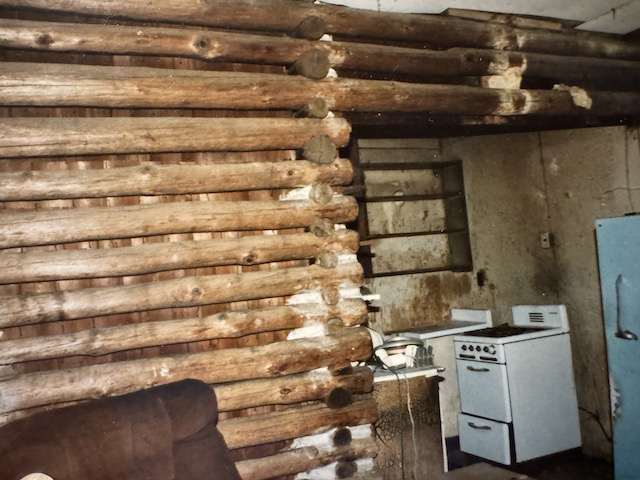
The log cabin was small and unique with about 14 logs top to bottom on each wall. There was little chinking inside and on some walls, the only covering was the outside small square wood siding.   It was certainly not weather tight. Chinking or daubing is a mixture of clay, mud, sand and sometimes wood splits that is mixed together and used to pack in between the logs to fill all gaps.  The purpose would be to prevent weather concerns, insect problems and air leakage. On the inside of their log cabin, some walls had only daubing where the corner logs met. It would be important to put some daubing at the corners to prevent log movement and they met that need with no worry. 

The Lee cabin had two four glass pane entry doors; one in the front and one out back with a screen door as well.  The steps were wooden and there was a single hand rail for support to come in and out. All of the way around side to side and front to back there was wood siding. By 1971 it looked weathered but in good shape.

Granny Lee died in August of 1996. Her tomb stone has a cross in the center.  She loved the Lord and lived out His principles.  She is buried next to her beloved Ezra at Evergreen Cemetery.  Her family eventually sold the land and the Lee log cabin was demolished for a beautiful and stately home made of brick and mortar.  I had a photograph framed and will give to the folks who live there honoring her legacy. 

See you Tomorrow,

Nan

Category: People, Westside | Comments Off on The Lee Log Cabin