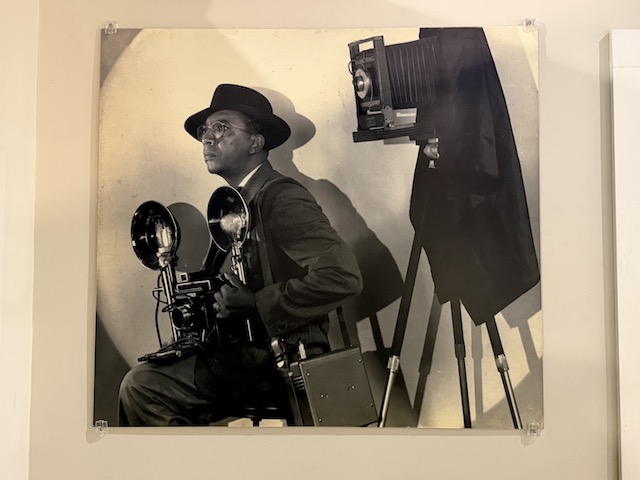
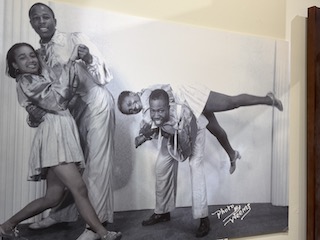
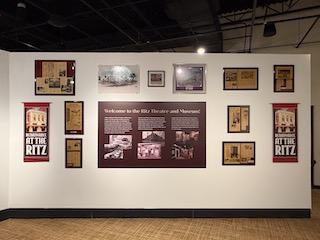
For over 50 years, Ellie Lee Weems (1901-1983) photographed and documented life in a segregated Jacksonville. He was born in McDonough, George and moved to Duval County in 1929. His home and business was located at 434 W. Beaver Street. From weddings, social events, graduations, parties, to just normal life, he captured it on film. The Ritz Theatre and Museum on Davis Street has a whole exhibit with photographs and information about the life of Weems.
E. L. Weems, Photographer (Ritz Theatre and Museum).
According to the Florida Times Union, he studied at Tuskegee Institute under Cornelius Marion Battey, “prominent photographer and instructor”. Weems died at the age of 82 and is buried in South-View Cemetery, Atlanta, Georgia.
Weems Photo (Ritz Theatre and Museum)
Many of Weem’s photographs can be seen at the Auburn Avenue Research Library, Ritz Theatre and Museum, and the University of North Florida. The exhibit at the Ritz Theatre and Museum highlights many of his important and historical photographs also showing his camera equipment type, and more.
Entrance to Ritz Theatre ( Ramey collection).
See you tomorrow.
Sources, Henry County, Institute, 193, Jacksonville.gov, Florida Times Union, Saunders Murray, Ritz Theatre and Museum, Find a Grave, Atlanta Constitution, Vaughan Publishing, Nannette V. Ramey.
Category: Art, Business, People | Comments Off on E. L. Weems, Black Photographer
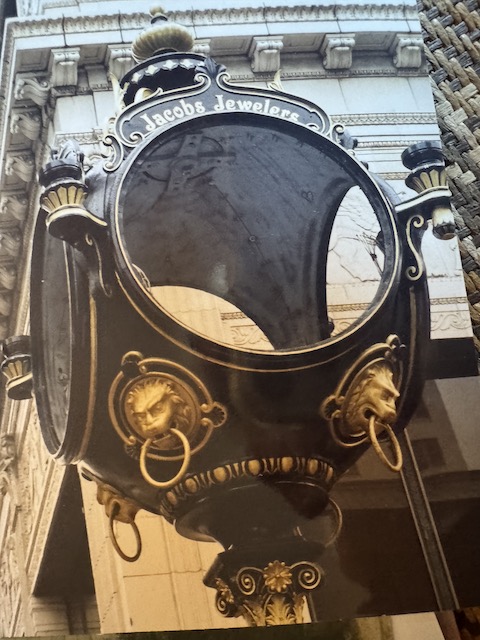
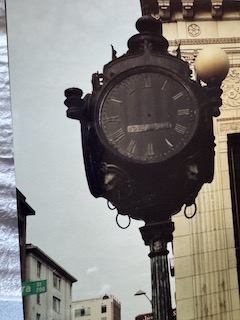
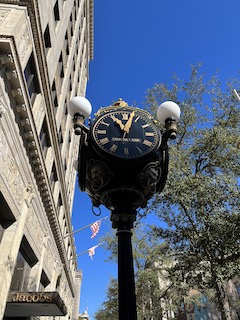
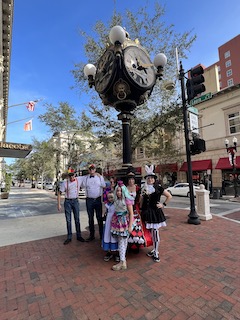
The Jacksonville Jacobs Clock is a four-faced time piece that currently sits at the corner of Adams and Laura streets in downtown. It was originally purchased for $1,200, called the Greenleaf & Crosby clock and placed outside of the Greenleaf & Crosby building at 41 West Bay Street in August 1901, after the Great Fire of Jacksonville.
Clock Repair to come -2011-(Ramey Collection)
The 15-foot-tall clock was built by the Seth Thomas Clock Company which began in 1813 and known for their “durability and wide variety” of clocks.The clock was moved to its current location at 208 N. Laura in 1927 in keeping with the Greenleaf Crosby jewelry store. There were some 100 clocks manufactured with this design and less than a dozen remaining.
Late 1980s (Ramey Collection)
Roy and Delorise Thomas purchased the jewellery store in the late 1960’s.and had the clock moved. Through the years it has had to have repairs and adjustments. The most extensive was in 1973 when it was almost destroyed by a city bus, in the mid 1990’s and 2011 when it was completely removed for roadway improvements. It was returned in working order in 2013. In 1995, the Thomas family donated the clock to the city of Jacksonville.
The Thomas’, owners of the clock retired in August of 2023 as the clock continued to tick on.
See you tomorrow,
Sources: Google AI Overview, The Business Journal, Jax Daily Record, Vaughan Publishing, Nannette V. Ramey
Category: Business, History | Comments Off on Jacksonville Jacobs Clock Lives Beyond Retirement
“Metro Jacksonville Archive” has an article that is titled “Myrtle Avenue Warehouse District”. Well, today, I can confirm that is true. I saw the biggest warehouse of random “stuff” that I’ve ever seen! As they say, “There are no words”. And, “there are no words!”
Myrtle and 18th Warehouse
Tim Gilmore wrote an article in December of 2025 titled “Step Inside the Underworld Catacombs of John Grant Dooley’s Old Brick Warehouse and Wonderland!” I read the article and made a visit to see it but found no success on the first try. There was a huge warehouse on the corner of Myrtle and 18th Street. It was beautifully painted and even had huge people-artwork on it. My understanding was that the warehouse was open on Tuesdays from 9-noon but I’ve found out since that’s not necessarily so.
The day I went (and begged my youngest daughter to go with me), the place was on lock down. ( Even the big 12 foot tall gate was locked!). I waited by the gate past 9 am just in case I got the time wrong but no one came. Disappointed, I wrote a note leaving my phone number and taped it to the keyless mechanical gate lock and we drove away.
Fast forward a few days and I got a call from “Johnny”, the owner himself that the warehouse would be open on the following Tuesday at 9 so again, I planned to go and again, begged the youngest to go with me.
When Tuesday came, I confirmed with the daughter and we met inside the open gate of this huge over 40,000 foot warehouse.
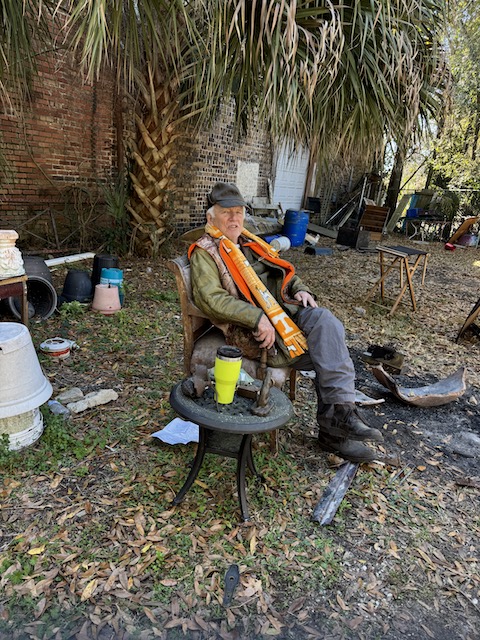
Before we entered, we actually met John Grant-Dooley. I’ll guess he’s in his late 70’s, quite friendly and passing the time outside of his warehouse as folks were coming in and out of the building.
It was a cool day in February. He was beginning a fire near the back entrance. Right away he was friendly and talkative. I introduced myself and said, “You must be Johnathan”. He said, “Johnny”. I corrected myself and said, “Yes, Johnny”. Then I told him I was the one who left a note on the mechanical lock box and I thanked him for calling me. He said he did not want me to miss the “opportunity to be overwhelmed.” He had told me to bring a flashlight which I did. And, overwhelmed is an understatement.
Johnny
The outside is beautifully painted in a blue background with the Black community honored with faces and such. Upon coming in the back gate, there is a lot of “stuff” at the large warehouse-size open door. Upon entering, the stuff, and that means anything from dolls, to money bags, instruments, saddles, busts, wheels, screws, hammers, photographs, posters, artwork, postcards, books, lamps, buckets, signs, wheel barrows, etc. ( I could fill this page with descriptions). Anything you can imagine and more are lining the floor, on shelves, in cubbies and the like. In some areas, you skinny through a pathway only to have to exit a different way. It’s truly “something you’ll have to see to believe”.
Posters and Frames and, and, and…
The two of us went in and right away were as Johnny said “overwhelmed”. The building is a 40,000 square-foot brick building that will certainly take you back in time like to the Beatles, Lynyrd Skynyrd, kings and queens, forest animals Tiffany lamps, dozens and dozens and dozens and dozens of horse saddles, dozens and dozens and dozens and dozens of movie posters. I could go on.
Awards of every kind
Over the years Johnny owned businesses such as the Five Points Theatre, Fans and Stoves and Ugly Junk. I’m not sure what he calls this business but when I asked how it all began he said he said that for many years he and his family decorated restaurants like chilli’s, Ruby Tuesdays and such. That’s when it all made sense.
Upon leaving, I talked with Johnny as he sat in front of the fire he made and the warehouse he built. He said he was the “White example of Sanford and Sons.” I liked that program. It overwhelmed me too.
See you tomorrow and maybe at the warehouse,
Sources: Metro Jacksonville, Tim Gilmore, Johnny Grant-Dooley, Vaughan Publishing, Nannette V. Ramey.
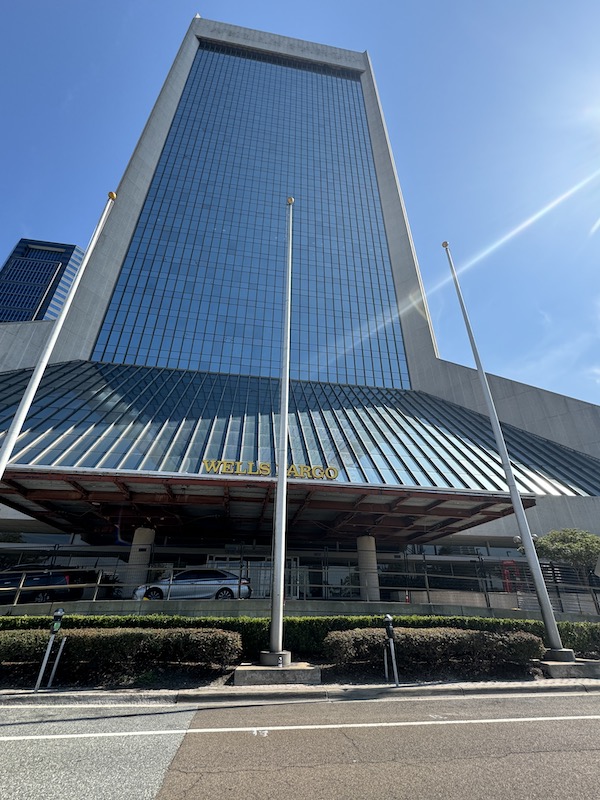
The tallest building in Jacksonville in 1974 was was known then as The Independent Life building at 535 feet. It was confirmed again in 2024 by James Abrams an expert in attaching and removing huge business lettering when he talked about the now 2nd tallest building in Jacksonville. Abrams was a part of the 2011 team that helped remove lettering from now-called 1 Independent Drive when the building changed owners. This is the 5th time the building will have letters removed atop this structure.
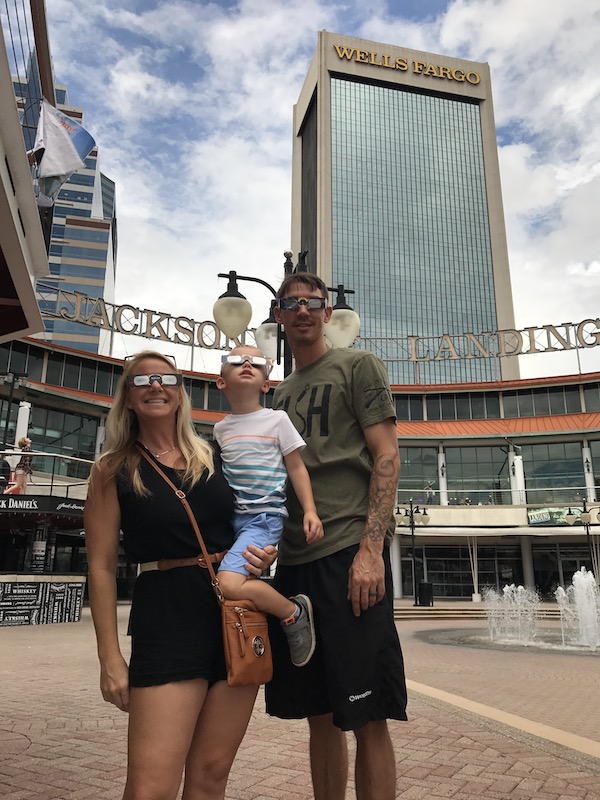
The Dingman Family, 2017 Eclipse with iconic Jacksonville Landing Sign and Wells Fargo Building in the background.
Over the years, the names have been: The Independent Life, Accustaff, Modis, Wells Fargo and until the new owner, Argentic Investment Management LLC of New York City renames it, the structure will be known as 1 Independent Drive. (Daily Record, Wells Fargo Center tower and garages Downtown sold for $46.35 million, Karen Brune Mathis, April 24, 2024).
There is a lot of history with the structure over the years including when the grounds were being prepared for building back in 1971. On a discovery walk with Gary Sass of Adlib Tours, we walked to the corner of Laura and Bay Street to learn that beneath this huge building lay still, a bonified locomotive which the contractors and owners of the day decided to leave. Instead, they built pilings around the locomotive leaving the metal train. A thirty-six-story building sits on top of a full-size locomotive in Jacksonville, Florida.
Gary Sass with Adlib Tours (Photo: Visit Jacksonville).
According to an article by Ennis Davis, the large locomotive could easily be explained as the area was once near a train line confirmed by maps. The train connection was used to distribute goods and services to the city of Jacksonville.(A Locomotive is Buried Below This Skyscraper, The Jason, Ennis Davis, January 8, 2017).
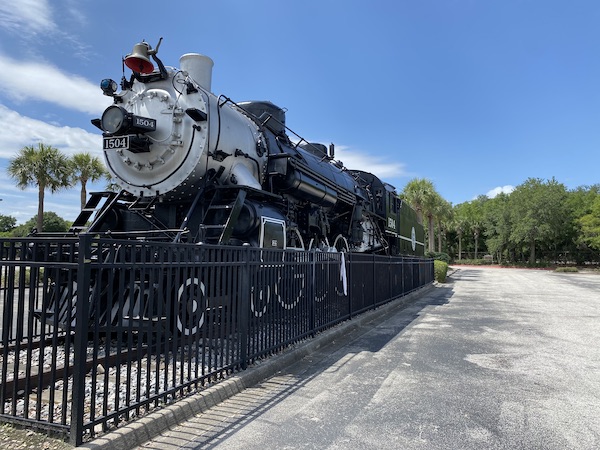
1504 Locomotive dates back to 1919 sat in parking lot of Prime Osborn for decades is a sample of an old locomotive. (Photo: Ramey).
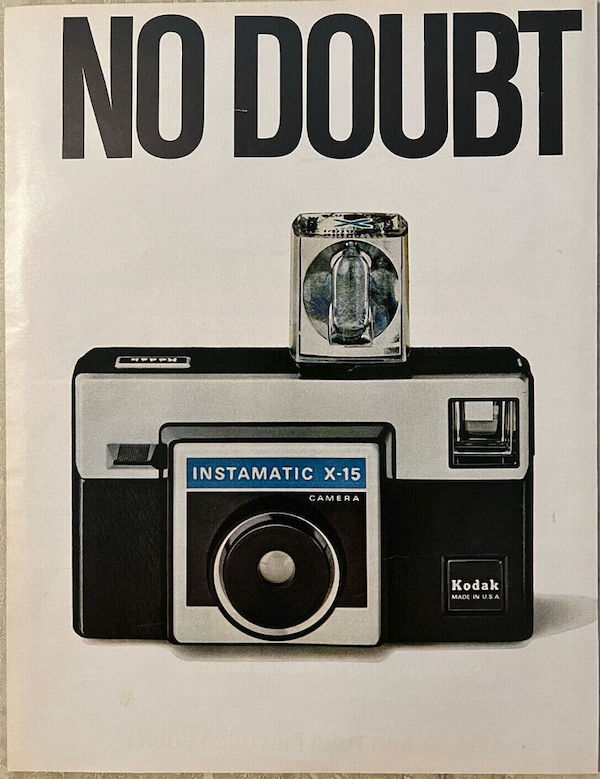
Too in this city, there could be, buried in the bottom of a Jacksonville home owner’s junk drawer and on someone’s 1971 Kodak Instamatic X-15 camera film roll, a photo of a buried steam engine which lay deep beneath the 5th named Independent Life Building located at the 1 Independent Drive in Jacksonville, Florida. It has yet to be revealed but maybe one day.
When the Well’s Fargo lettering was placed on the building at the time it was re-named Wells Fargo, James Abrams, sign technician, was one of those wearing a repelling harness to work with the bolts and attachments, in preparation for the changes back then. He said Dave Clark was a part of this team repelling on the side of the 535 foot high building on this occasion. The owner of High Angel Services Jim Webster reported to Chanel 4 news that precision was important for the safety of all involved. The weather was clear, the wind mild and the crew professional.
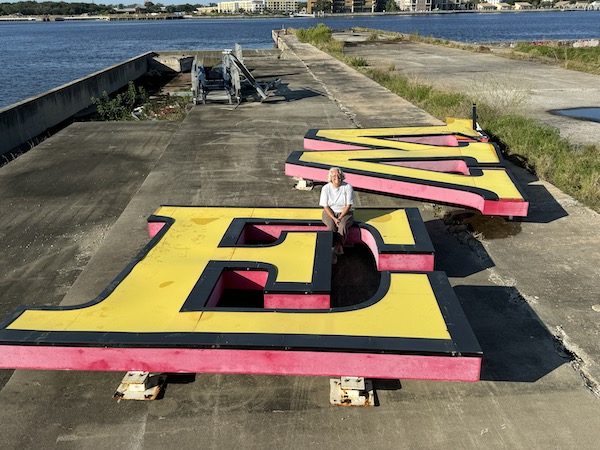
Wells Fargo letters after being removed from the building 2024 (Ramey archives)
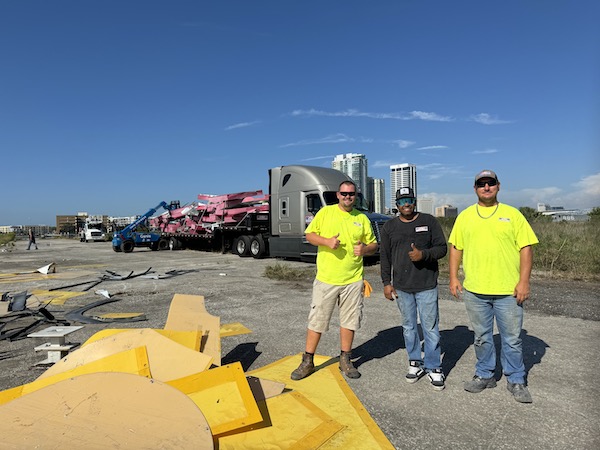
Abrams has been involved once again as I met him at the landing area located across from the Maxwell house Coffee plant where letters from the building were flown. Two others heavily involved in the process of letter removal were Alexis Casul, and Kyle Roberson, all who work for Southeastern Lighting Solutions. They were tasked with receiving each 1,500 pound letter by the vintage 1953 Sikorsky S-58 helicopter. ( Florida Times Union, Wells Fargo sinage comes down with help of 1958 vintage helicopter, Bob Self, July 14, 2024).
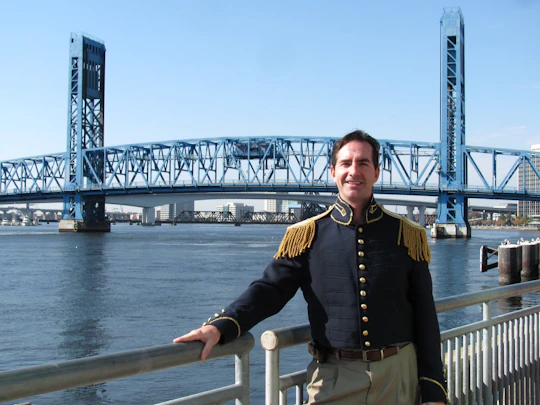
Kyle Roberson, Alexis Casul, James Abrams of Southeastern Lighting Solutions (Photo: Ramey)
There, the twenty, approximately 17 foot, tall, 1500 pound letters were brought after being removed from the once-named Wells Fargo Building on July 14th, 2024. The huge letters were then prepared one at a time with a steel cables for each letter and hoisted far above the building. The letters were then flown by helicopter to the open area to be received by hand, one at a time. As the helicopter hovered over the men, the letters were hanging and with careful precision, each one was held by the helicopter cable, handled by the men, lowered to the ground and unattached by the waiting crew.
By Tuesday of that week, the men had detached the bright orange letter covers, removed all lights inside of the metal lettering and had them stacked on a flat bed truck ready to be recycled.
For now, the steam engine, confirmed by eye-witnesses back-in-the-day, lay undisturbed since 1971 when the iconic building was built and named for an accident insurance company. The naming rights of the building belonged to the then owner, Independent Life.
For now though, all we know for sure is that on Sunday, July 14, 2024 eye witnesses saw a helicopter hang at least twenty, 1500 pound letters swagging in the air removing them to make way for the next Independent Life Building owner, Argentic Investment Management LLC of New York City to have new lettering place atop the approximately 650,000 leasable square foot building. ( Daily RecordHelicopter removes Wells Fargo signage from Downtown Jacksonville tower.
Oh, but if locomotives could talk.
Category: Buildings, Business | Comments Off on Letters Removed From the Top of the Wells Fargo Building. Locomotive Still Beneath the Pilings
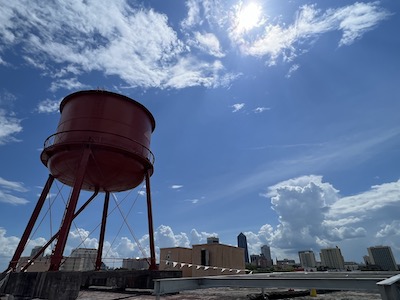
When you’re flying across the Matthews bridge and come to the bottom at the first intersection, you look right and see a huge red water tank atop a massive, long cement monster of a building, you’ve arrived. That is the old 700 East Union Street storage and commercial building. For years, according to Chris Sandstrom, seamstress and artist in her own right noted there were spaces there for creative efforts over the years. She said, “We had quite the community of business people there”. Who knew that for years and years the area was used for businesses, artists and more to sell and work on their crafts!
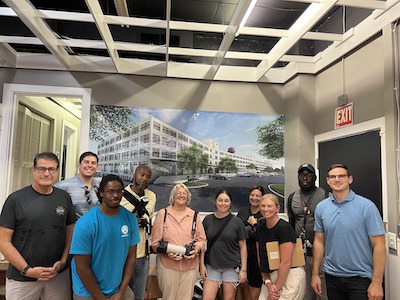
Photographers standing in front of the proposed new look for 700 Union St.
In 2018, it was bought by Columbia Ventures LLC and five years later photographers were invited to take a couple of hours to photograph the old building til’ their hearts content in order to preserve some of its history.
According to records, the 7.99-acre site was bought for $4.5 million and is being renovated into apartments, housing units and a restaurant. On the day we arrived the place had been completely gutted and inside walls were going up. Also, the earth-movers were clearing out the grounds for parking space and yard renovations. There was a lot going on. As Sandstorm said, “Soooo much history in that building”.
The day went off without a hitch. Photographers, and even wanna-be photographers like me went to the main office, signed waivers, promised photos of some sort and spent a hard-hat-day walking the span of this age-old building for a couple of hours. Before walking on the site, all visitors saw a safety video, had specific instructions by employees about the do’s and don’ts and each person was given a safety hat.
The photo-tour was guided by three employees, Ryan, Ormondo, and Tore, spending about 20 minutes spent on each floor with the bonus of walking beneath the old water tower on top. On every floor, a reminder of safety instructions were given to ensure well-being.
Photographers then were let loose to walk anywhere there was not caution tape. The thoughts were that through the eyes and lens of many photographers, they may capture some of the history in order to preserve it in a long-lasting way. Photos will possibly be used for wall space, in foyers, apartments, offices and more.
Certainly, historians should be thrilled that not only is the building being repurposed but even history such as the photograph of old bottles, wall cracks, metal doors, old light switches, locks, and even old rivets have been documented.
The next time you’re flying across the Matthews Street Bridge, look right and you’ll see preservation at its finest. Oh, and ‘A shout-out to Columbia Ventures for having such a vision so as to preserve a building built in 1913 and even with vision to preserve the nuts, bolts, bottles and more!
See you tomorrow,
Nan
Sources: Jacksonville Daily Record, Duval County Tax Records, Wikipedia, Personal Visit.
Category: Buildings, Business, History | Comments Off on Photographing 700 E. Union St. 100 Year Old Bldg.
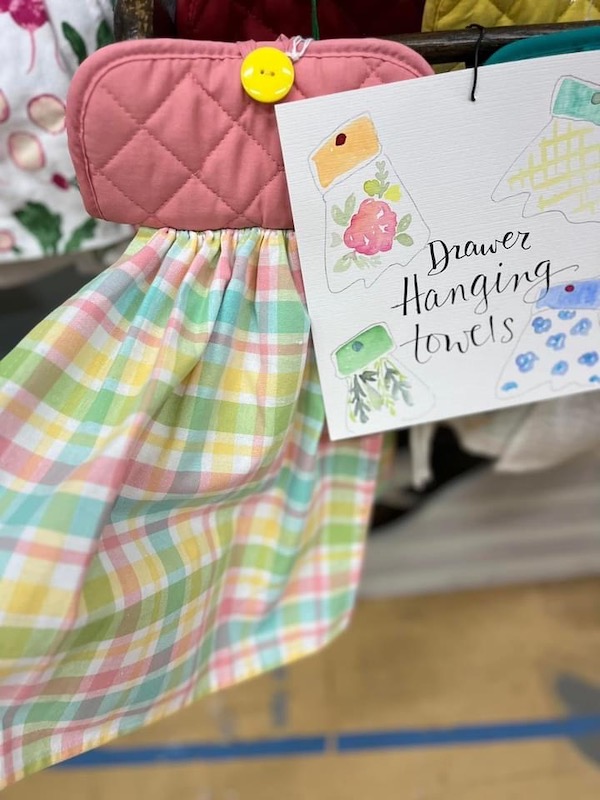
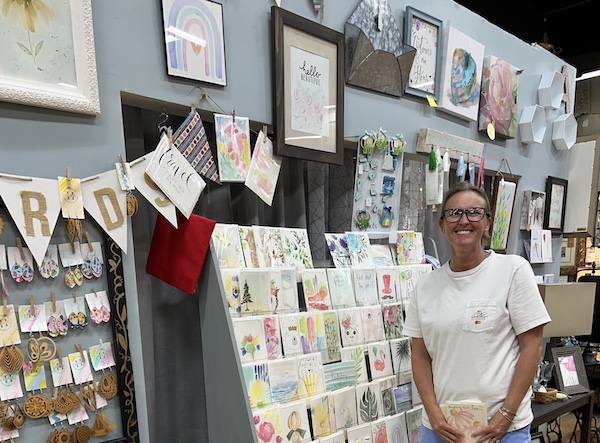
You MUST visit the Great AmericanAntique Mall at 9365 Philips Highway Suite 114 to see in person the handmade items in Heather Hills space in the store. She actually has at least two separate areas in the store where you can view and select her artwork(watercolors and kitchen cloths) to find the exact gift for your loved one or treat yourself.
Photo from Great American Antique Store
Originally from Ohio, Heather has shops there and in several other shops in the United States. In Jacksonville, she has at least three areas where her work can be found plus her online Facebook page. She began her business Hill and Co. back when she began helping her young five year-old, now a young adult to watercolor. She said, “It all came back to me” and she’s been producing art work since. She needed an outlet to share all of her pieces and now it’s a thriving work of art in several shop locally and elsewhere.
You can also check her out on the Great American Antique Store Facbook page. If you go and see her, tell her I sent you.
Don’t miss out on checking our her work. It will not disappoint.
As you know, Mother’s Day is up and coming but you can use these items for many occasions.
The most secure depository in the world is said to be that of Fort Knox. It is operated by the United States Department of Treasury. It seems to me and I’m no security expert, that the original three banks of downtown Jacksonville could have given Fort Knox a “run for the money” in terms of security back-in-the-day.
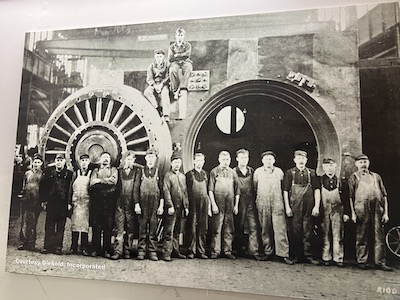
Diebold vault workers (Sass Collection-Diebold via Jacksonville Blogger)
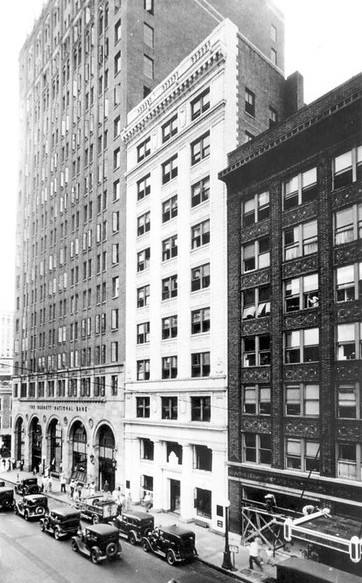
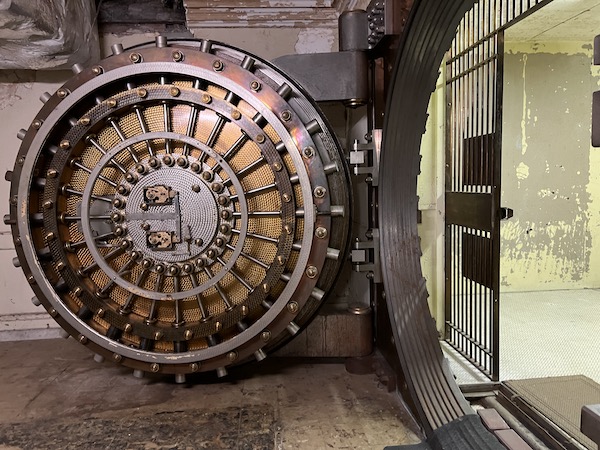
There are, at this moment still, in 2023, huge vaults under banks in downtown Jacksonville. If you take the Gary Sass tour you can see at least two and actually walk inside of one of them. Don’t close the door because if they can’t open some of the safes that have been there since 1877, they may not have the combination or key to the huge circular tumblers that open the vault. On the tour you can walk under the city streets , in tunnels prepared for vault use in the late 1800’s and early 1900’s by Jacksonville bankers.
Early Banks in Jacksonville (Florida Memory via Jacksonville Blogger)
It has been suggested that the vaults were so big, they were put in the ground first and the banks built on top of them. For years they were used to store three of the biggest banks in Florida’s money. When the downtown Jacksonville boom burst, the vaults were left unoccupied and unused.
The Barnett Bank of Jacksonville opened on the corner of Forsyth and Main in 1877. It would become the largest commercial bank in Florida with an excess of 600 offices and over $40 billion in deposits. The buildings with vaults beneath them still stand.
The Atlantic National Bank began in 1903. Banking efforts have changed hands over the years and today it is called Wells Fargo.
The Florida National Bank opened in 1905 which would become the 2nd largest bank in Florida at some point. All of those banks used the vaults for transferring money.
Through the years there have been many changes. There was the Great Fire of Jacksonville, Indian ‘wars, the Civil War, but one thing that has not changed is the huge vaults that once provided safe storage for the millions and millions and million of dollars, certificates and actual gold stashed in them for safety. Of course, there is no money there(that we know of) but the vaults are safe.
The tour begins by going underground and walking through several tunnels. The tunnels, for the most part look like office walls and walkways until you realize you’re under Forsyth Street, and then Julia Street and you look to see how the path goes down.
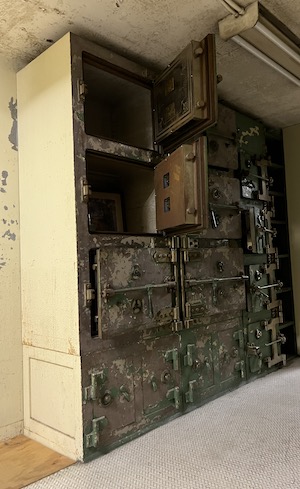
When you get to the end, you walk through a door to see a huge Diebold vault. This company was known for it’s security of money, valuables, records and more late in the 1880’s. It’s truly an “ah ha” moment when you see the huge gold-bronze looking safe. It makes you want see more, turn its tumblers and close the door. In the vault area, are old lock boxes that individuals would rent, some that are still closed and no one knows the combinations or have keys to the century old relics. If confederate money is in there, there is no value anyhow. Right?
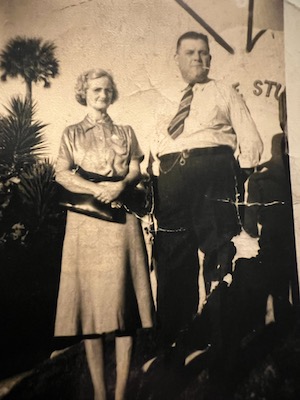
Born a Georgia boy, Hoyt. E Thurmond had found a wife in Minnie Lee and was living at 425 West 23rd Street in the “Sunshine State” by 1933. Hoyt was born on December 8, 1889. After leaving Georgia, he married Minnie and they moved to the Springfield area in Jacksonville, Florida.
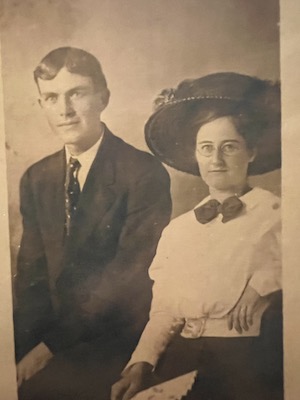
Hoyt and Minnie- Photo-Linda Lee Hollister
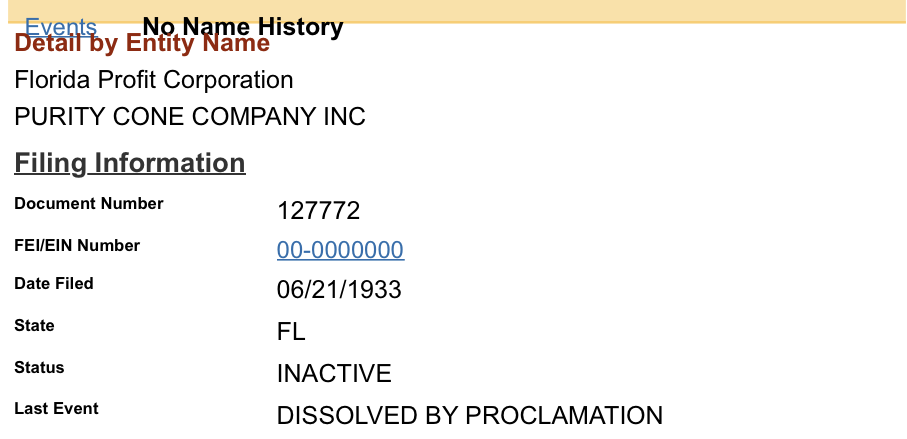
Just around the corner in Springfield area in Jacksonville, he opened a cone company supplying fresh ice cream cones to small mom and pop parlours; crispy and fresh . Hoyt’s business license was filed in 1933 with the state of Florida.
Purity Cone Florida Corp. 1933
Linda Lee, one of his granddaughters says she remembers eating the small broken pieces left inside of the machine from the freshly-made cones. It was “oh-so good” she remembers after reminiscing about her Papa’s cone business. Gail, another granddaughter said they would often ride in a delivery truck being a part of the distribution process that came with expanding the business throughout the city of Jacksonville. That trip always resulted in the treat of “eating a broken cone or two”, she said.
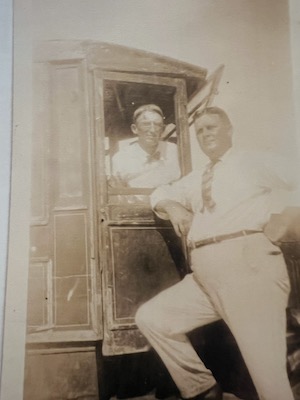
Purity Cone Truck with Mr. Parker and Hoyt Thurmond. Photo: Linda Lee Holister
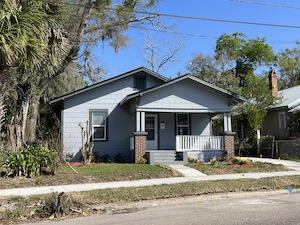
The Purity Cone Company of Jacksonville, was located on 20th Street in the Springfield area. Springfield was established in Duval County in 1871 as an actual development of John Norton, builder and financier. After the 1901 fire of Jacksonville, the city expanded its growth and Springfield was one area brought to life to include large stately homes and big beautiful facades and front porches with a variety of businesses to meet the needs of the growing population. It had its own “Main Street” and the area became popular as well as businesses and churches for residents of the city. Lots were small but many homes were grandeur for that day and time. Houses ranged in sizes from two bedrooms to as many as 6 bedrooms. Some homes were two story including a wrap-around porch while others were one level The Thurmond’s lived in a three bedroom home with a nice-sized front porch, on the west end of the street in a very nice single story small bungalow.
Hoyt home on 23rd Street, Jacksonville. Photo- Ramey Collection.
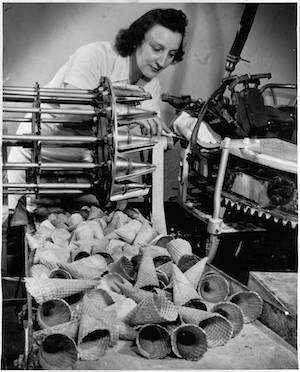
The Purity Cone Company was founded in Minneapolis 1929. It appears Hoyt would contract with the company, get his own equipment and start his company in 1933 selling fresh cones from a batter “ consisting of cake flour, sugar, syrup, vanilla, shortening, and salt”. Cones were made ranging in size from 4 to 5 inches. They were made fresh in the Jacksonville location and distributed city-wide using a truck.
Purity Cone machine.Photo- Wiki Commons
There have been other Purity businesses in the United States related to cones such as the Purity Ice Cream of Ithaca, New York, Tennessee and Minneapolis. The Purity Cone business of Jacksonville appears to be an outgrowth for the cone business and not particularly ice cream. Hoyt and Minnie had three daughters, Wilma Lee Beal, Gladys Elma Weathers, Alice, and two sons, Jones and Tommy, all of Jacksonville, Florida. He died March 26, 1958 and he and Minnie are buried in Evergreen Cemetery.
Hoyt and Minne Thurmond-Photo Linda Lee Holister
While currently driving around the Springfield neighborhood, the family home still stands. The Purity Cone Company, a well-remembered memory to the family is gone because of the 20th Street expressway that has taken it’s place. The memories are still there with those who remember. “Cone crumbles are still good” said grandchild, Gail Thurmond.
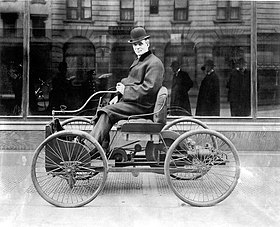
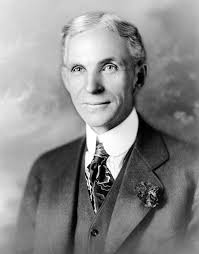
Henry Ford revolutionised the way of travel world-wide. The 1896 the quadricycle was the first vehicle on four bicycle wheels. It was powered by a four-horsepower engine.
Ford Quadricycle- Photo- Ford Company
With 12 investors the Ford motor company was incorporated in 1903. By 1907, the inventor had the now-famous scripted “Ford” logo.
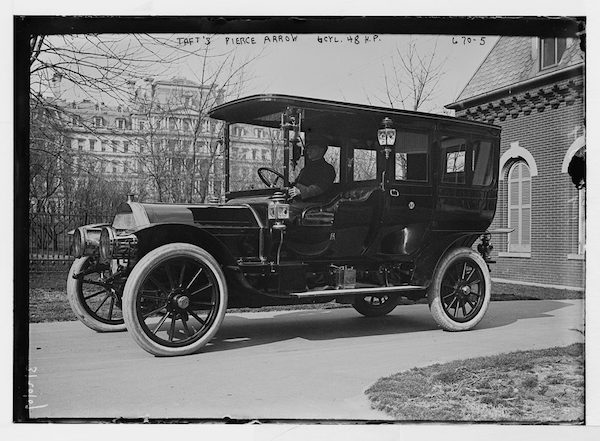
HIs 1907, his first assembly line was in Highland Park, Michigan. He purchased a 130-acre tract of land and would build a factory to speed up wheels on the ground.By 1908, the Model T automobile was introduced and the assembly line was set up to mass produce autos. From there the auto industry was on the move and on the rise. According to Whitehousehistory . org, “Congress appropriated $12,000 for the purchase of the first two White House motor cars despite heated protests”. Pierce Arrow was the first chauffeur for President William Taft.
Whitehouse first car- William Taft- Photo- White House
Henry Ford was a busy man and traveled from place to place, even abroad. In time he had as many as 31 plants . This was all before the Great Depression.
Ford traveled on Flagler’s Florida east coast railway and at the invitation of Inventor Thomas Edison took his wife Clara and son Edsel to visit Fort Meyers, Florida They liked the vacation so well, Henry Ford bought a 2 story riverfront home there next to Edison.
Ford Estate in Fort Meyers
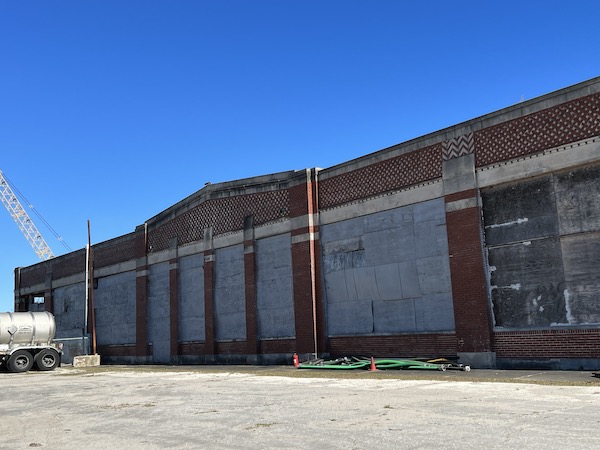
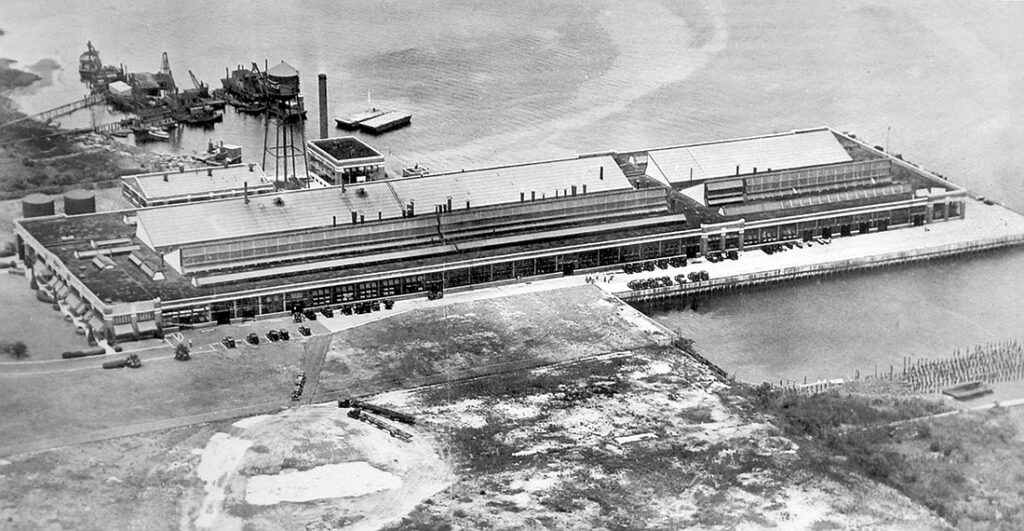
With the auto industry booming, factories were being made and in 1924 Jacksonville, Florida would join Charlotte, NC, Chicago, Il, Memphis, Tn, Salt Lake City, UT in having an assembly-line plant. The Jacksonville, Florida factory was on the St. Johns Riverfront at 1900 Wambolt Street. It served from 1924-1932.
Ford Plant- Photo- 2022- Ramey
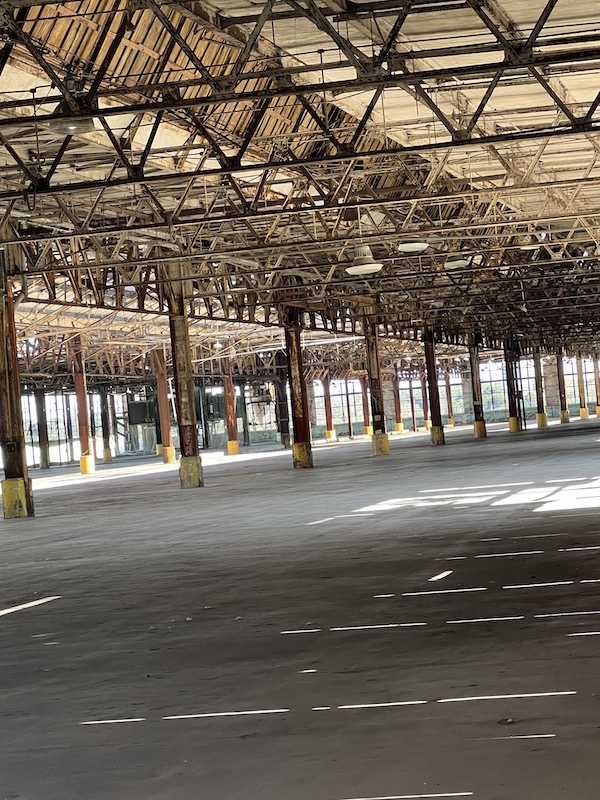
The Great Depression hit from 1929-1939 affecting so many businesses. It is believed the boom of the 1920’s, a stock market crash, poor management of the Federal Reserve and other causes brought about this downturn.The Jacksonville, Florida Ford plant was one of them. This period of serious economic depression affected everyone and the auto industry was hit hard. The Jacksonville plant closed in 1932. Over the years following, the land-area was used for parts and distribution which ended in 1968. From then until about 2015, various companies used the space including a wooden pallet manufacturing business.
Ford Plant- 2022- Ramey
The Jacksonville Historic Preservation group was in hopes of saving the Ford Manufacturing plant naming it a designated local landmark in 2003. In 2015, the same year it was purchased by Amkin Hill Street LLC, Henry Ford was inducted into the Florida Inventors Hall of Fame. Over the years the factory building has been in disrepair and every day losing its former glory.
Ford Plant Jacksonville- Florida Memory
In October of 2022, Mike Mendenhall of the Jacksonville Daily Record announced that the “Jacksonville City Council will allow the owners of the historic former Ford Motor Co. factory in Talleyrand to demolish the 97-year old riverfront landmark for a possible maritime industrial redevelopment project”. This was a sad day for the historians of Duval County.
We’re living in sad days where our history is continually removed but , keep taking those photos so we can at least have the memories…..
Remembering Henry Ford- Florida Memory
The original Michigan Ford Motor Auto plant remains in tact. It was made a National Historic Landmark in 1978.
See you tomorrow,
Nan
Sources: Ford Motor Company, Whitehouse. Org, Jacksonville Daily Record, Mike Mendenhall, Wikipedia, Personal visit to the plant-Ramey.2-2-23
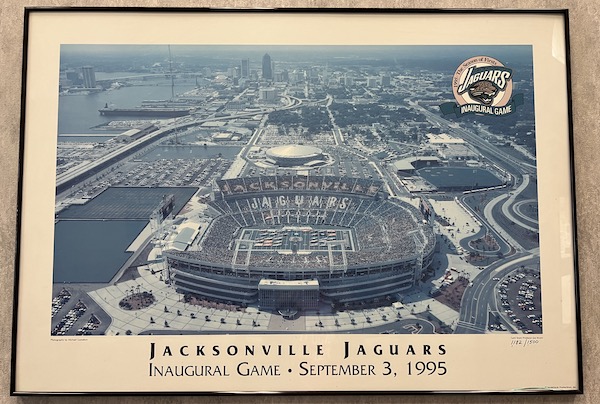
Hanging on the wall of the Family Medicine Doctor office on University Blvd. S. is an original copy of the inaugural Jaguars football game photo from 1995. On that day, September 3, Kivett Productions had the contract to gather together X number of people, provide specific seats for them, give them a packet with instructions and possible coupons, offers, etc. Then, at the given time and with “cue-card-holders” instruction have them flip their card to produce a huge human-type billboard. Even the cue-card-holder has a cue card! In this case, the Jaguars’ fans flip-cards and which when combined, reads, “Jacksonville Jaguars” and the photographer from the airplane in the sky went, “click”. This is the ultimate human billboard!
Kivett productions is said to the the world leader in this effort. They promote their card flip advertising and it is a performance in itself, indicating that they “design, print and distribute things related to it, engage the audience as “part of the event” and have participants move on “cue” to get a final results.
In this article photograph, you can clearly see the words”Jacksonville Jaguars” and here we are in the year 2023 with that photo hanging on the wall remaining a snapshot and iconic moment in time from 1995.
The framed item above is number 1,182 out of 1,500. Don’t you wonder where the other 1,499 are? The TIAA Bank Stadium can seat over 60,000 fans and can be expanded to 80,000 if needed so having one of the 1,500 posters is a definite collector’s item.
The 2023 Jaguars team is now in the playoffs for the Super Bowl. I wonder if promoters will hire Kivett Productions again for the playoff games? Super Bowl? Yours thoughts? 1/19/23